
For Canadians looking to know more about the E-2 Visa Requirements for Canadian Citizens, this article is meant to provide all the essential information as Canada is one of the countries that qualifies for both the E-1 Treaty Trader and E-2 Treaty Investor categories.
That gives Canadian entrepreneurs, investors and business owners two separate ways to build or expand a U.S. business presence. The U.S. Department of State lists Canada as eligible for both E-1 and E-2 treaty classification.
E-2 Visa for Canadians – key advantages

Canadians can use both E-1 and E-2 options
Many treaty countries qualify for only one category, but Canadians may be eligible for either:
- E-1 Treaty Trader — for Canadians conducting substantial trade between Canada and the United States.
- E-2 Treaty Investor — for Canadians investing in and operating a U.S. business.
This is a major advantage because the applicant can choose the category that best fits the business model. A Canadian exporter, importer or service provider may fit E-1, while a Canadian purchasing a U.S. company, opening a franchise, or launching a U.S. operating business may fit E-2.
Strong Canada–U.S. commercial relationship supports E-1 cases
The E-1 category is particularly practical for Canadians because Canada and the United States already have deep cross-border trade ties. For E-1 purposes, the applicant must generally show substantial trade and that the principal trade is between the United States and the treaty country. For a Canadian business, that means Canada–U.S. trade must be central to the enterprise.
This can benefit Canadian companies involved in:
- Exporting goods to U.S. customers
- Importing U.S. goods into Canada
- Cross-border professional services
- Logistics, trucking or transportation
- Software and technology services
- Consulting
- Manufacturing supply chains
- Wholesale distribution
- Tourism or hospitality services
E-2 Visa for Canadians can be more accessible than some other U.S. business options
The E-2 visa for Canadians does not have a fixed statutory minimum investment amount. The investment must be “substantial” in relation to the business being purchased or established, but the appropriate amount depends on the nature of the enterprise. This can make E-2 visa requirements for Canadian Citizens more flexible than programs that require a fixed capital threshold.
The E-2 visa requirements for Canadians allow for:
- Buying an existing U.S. small business
- Opening a franchise
- Starting a consulting or service business
- Expanding a Canadian company into the U.S.
- Acquiring a restaurant, café, retail business or trades company
- Launching a technology, logistics or professional-services operation
No lottery requirement
Unlike H-1B visas, E-1 and E-2 visas are not subject to an annual lottery. Special E-2 visa requirements for Canadian citizens mean that the applicant does not need to wait for a random selection process. If the business and applicant meet the requirements, the case can proceed through the E visa application process.
The U.S. Embassy in Canada specifically describes E-1 and E-2 visas as treaty-based options for citizens of qualifying treaty countries.
Renewable while the business remains eligible
E-1 and E-2 visas are temporary, nonimmigrant visas. However, they can often be renewed as long as the business continues to qualify and the applicant continues to meet the visa conditions. This is useful for Canadians who want to operate a U.S. business over several years without immediately pursuing U.S. permanent residence.
The practical benefit is that a Canadian entrepreneur may be able to live and work in the U.S. for the qualifying business, renew the visa, and continue operations if the trade or investment remains compliant.
Spouse and children can accompany the principal applicant
A Canadian E-1 or E-2 applicant can generally include a spouse and unmarried children under 21 as dependents. The U.S. Embassy in Canada notes that dependents do not have to hold the same nationality as the principal applicant.
This is an important family-planning advantage. Children may attend school in the United States, and spouses in E dependent status may benefit from employment authorization rules, subject to current documentation and I-9 compliance requirements.
Useful for Canadian business expansion into the U.S.
The E visa structure is well suited to Canadian companies that want to enter the U.S. market without relocating the entire business. A Canadian company may set up a U.S. subsidiary or affiliate, use E-1 if there is substantial Canada–U.S. trade, or use E-2 if Canadian nationals own and invest in the U.S. enterprise.
This can be attractive for companies in:
- HVAC and refrigeration
- Construction and trades
- Food services
- Hospitality
- Logistics
- Manufacturing
- Software
- Engineering
- Consulting
- Wholesale and distribution
Canadian citizens often have practical consular access
Canadian applicants generally apply through the U.S. Embassy or Consulates in Canada, subject to the post’s specific E visa procedures. The U.S. Embassy in Canada provides E visa instructions, document checklists and renewal guidance for E-1 and E-2 applicants.
This does not mean approval is automatic, but it gives Canadians a defined local process for preparing and submitting the application.
E-1 and E-2 can cover key employees, not only owners
The visa is not limited to the main investor or trader. Certain executives, managers, supervisors or essential-skills employees may also qualify if they have the same treaty nationality as the treaty enterprise. This is useful where a Canadian-owned company needs to send key Canadian personnel to the United States to manage or support the U.S. operation.
For example, a Canadian refrigeration company opening a Seattle branch may need a Canadian operations manager, technical specialist or senior installer to establish the U.S. business. Depending on the facts, E classification may be available.
Lower upfront government filing cost than many business immigration routes
The Department of State currently lists the E-category nonimmigrant visa application fee as US$315, although other costs may apply, including legal fees, document preparation, business setup costs, translations, courier fees and potential reciprocity fees depending on nationality.
The bigger financial issue is not the visa fee; it is whether the trade or investment is properly structured and sufficiently documented.
Why this is particularly attractive for Canadians

The biggest Canadian advantage is flexibility. A Canadian applicant may be able to structure a U.S. business strategy around either cross-border trade or business investment.
A simplified decision framework:
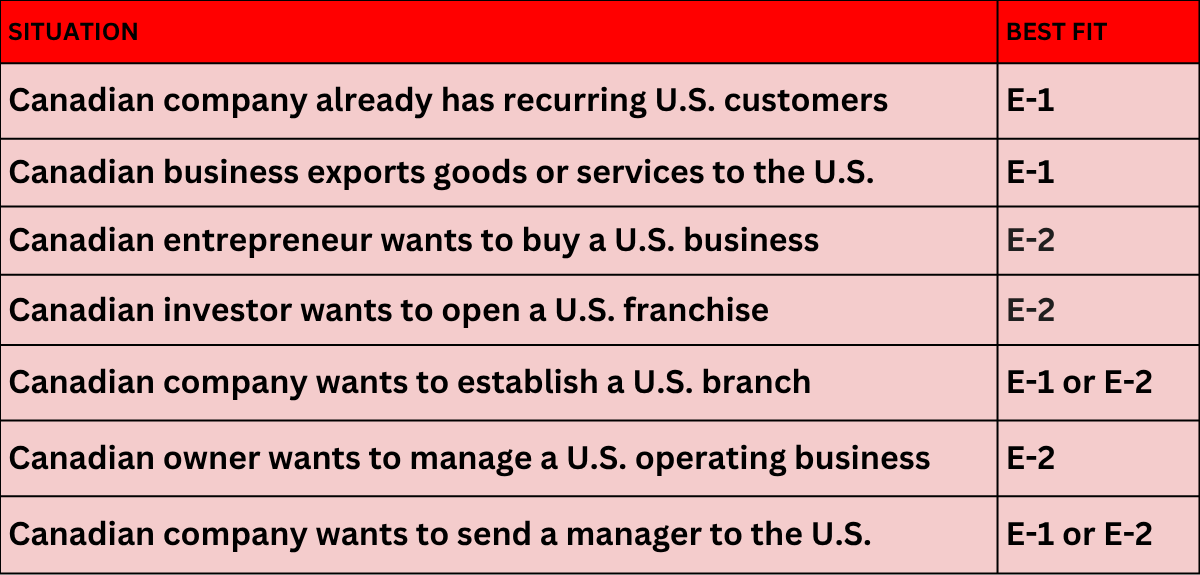 Strategic benefit compared with other U.S. visa options
For many Canadians, E-1 and E-2 may be more commercially practical than other U.S. work visa categories because they are directly tied to business ownership, trade and investment. Unlike TN status, which is tied to specific professional occupations under the USMCA, E status can support entrepreneurs and business operators. Unlike H-1B, there is no lottery. Unlike L-1, the applicant does not necessarily need a qualifying foreign company relationship and one year of prior employment abroad, although L-1 may still be better for some multinational businesses.
E-2 Visa for Canadians: Key Cautions
The E-1 and E-2 categories are powerful, but they are not automatic for Canadians.
Applicants must still prove:
- Canadian citizenship
- Qualifying treaty ownership
- A real operating business
- Substantial trade for E-1
- Substantial investment for E-2
- Lawful source of funds for E-2
- A non-marginal business for E-2
- A qualifying executive, managerial, supervisory or essential role
- Intention to depart the United States when E status ends
E-1 and E-2 are also not direct green-card categories. They may support long-term business presence through renewals, but permanent residence requires a separate strategy.
Immigrationgurus.Ca and its team of affiliated lawyers are experts in the E-2 Visa Process.

E-2 Visa Requirements for Canadians – Bottom Line
For Canadians, the E-1 and E-2 visa programs offer a highly useful U.S. business-mobility pathway. The main advantages are access to both treaty categories, strong Canada–U.S. trade compatibility, no lottery, renewable status, family accompaniment, potential spouse work authorization, and the ability to operate or expand a real U.S. business.
For Canadian entrepreneurs, the practical question is usually not “Does Canada qualify?” It does. The real question is whether the business is better structured as an E-1 trade case or an E-2 investment case.