

For entrepreneurs, investors and business owners seeking to expand into the United States, the E-1 Treaty Trader visa and E-2 Treaty Investor visa can provide valuable temporary immigration options. Both categories permit qualifying foreign nationals to live and work in the United States while conducting approved business activities.
Although they are frequently described as immigration programs, E-1 and E-2 visas are technically non-immigrant visas. They do not automatically provide permanent residence or a U.S. green card. Applicants must demonstrate an intention to leave the United States when their E status ends, even though qualifying status may potentially be renewed while the underlying business continues to satisfy the applicable requirements.
The central difference is straightforward:
- The E-1 visa is based primarily on substantial international trade.
- The E-2 visa is based primarily on a substantial investment in an active U.S. business.
Both options are restricted to nationals of countries that have an applicable treaty or qualifying agreement with the United States.
What is the E-1 Treaty Trader Visa?
 The E-1 Treaty Trader visa allows a national of an eligible treaty country to enter the United States to conduct substantial trade principally between the United States and the applicant’s treaty country.
Qualifying E1 Visa Trade may involve:
- Physical goods
- Professional or commercial services
- Banking and financial services
- Insurance
- Tourism
- Transportation
- Communications
- Data and technology; and
- other forms of international commercial exchange.
The trade must be substantial, meaning there should normally be a continuous flow of meaningful transactions rather than one isolated sale.
An E-1 Visa Applicant may qualify as:
- The principal treaty trader;
- An executive or manager of the treaty enterprise;
- A supervisory employee; or
- An employee with specialized skills essential to the operation.
Typical E-1 Visa example
A Canadian industrial-equipment company regularly exports refrigeration components from Canada to customers throughout the United States. The company establishes a U.S. operation to manage sales, distribution and customer support. If the volume and frequency of Canada–U.S. trade are substantial and the ownership requirements are met, the principal owner or qualifying employees may be candidates for E-1 classification.
What is the E-2 Treaty Investor Visa?
 The E-2 Treaty Investor visa allows a national of an eligible treaty country to enter the United States to develop and direct a business in which the applicant has invested—or is actively in the process of investing—a substantial amount of capital.
- The investment must be:
- Placed at commercial risk;
- Committed to a real and operating U.S. enterprise;
- Substantial in relation to the cost of purchasing or establishing the business;
- Lawfully obtained; and
- Sufficient to demonstrate the applicant’s commitment to making the enterprise successful.
Money merely sitting in a personal or business bank account is generally insufficient because it remains uncommitted and may be withdrawn.
There is no universal minimum E-2 investment amount stated by the U.S. Department of State. The appropriate amount depends on the nature and cost of the business. For example, a consulting company may require less capital than a manufacturing plant, hotel or restaurant.
The enterprise cannot be marginal. It should have the present or future capacity to generate more than enough income merely to support the investor and the investor’s family, or it should make another significant economic contribution, such as creating U.S. employment.
Differences between the E-1 Visa and E-2 Visa
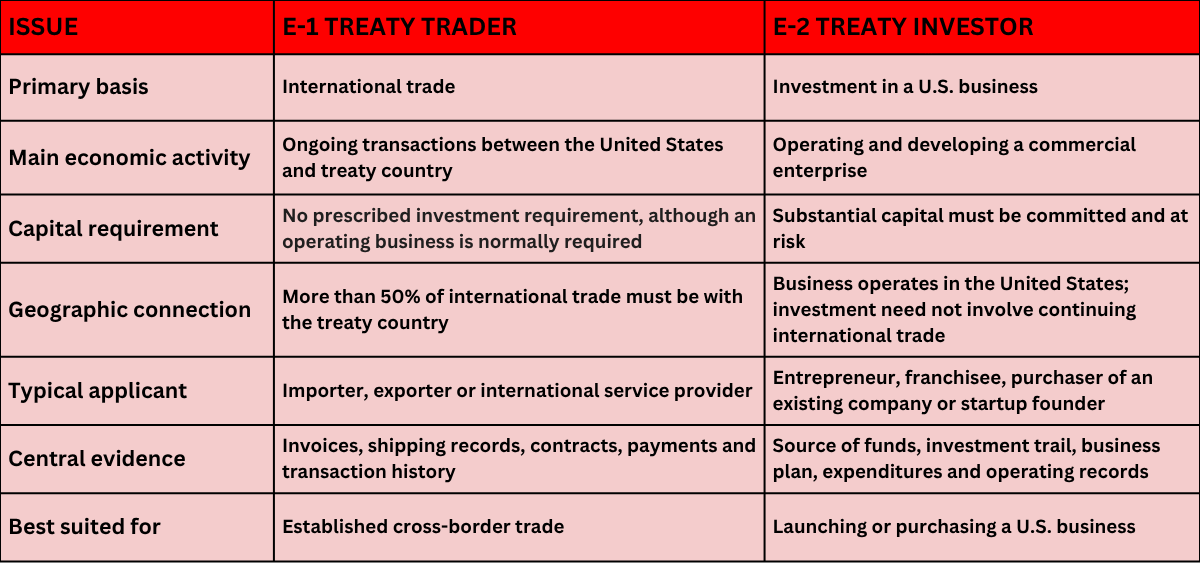 Some applicants may potentially satisfy both categories. For example, a Canadian company could invest significantly in a U.S. subsidiary while also conducting substantial Canada–U.S. trade. The strongest classification will depend on the ownership structure, transaction history, investment and applicant’s intended role.
Which countries qualify for the E-1 Visa?
As of the date of publication, the U.S. Department of State lists the following countries or qualifying jurisdictions for E-1 treatment:
Argentina, Australia, Austria, Belgium, Bolivia, Bosnia and Herzegovina, Brunei, Canada, Chile, Colombia, Costa Rica, Croatia, Denmark, Estonia, Ethiopia, Finland, France, Germany, Greece, Honduras, Ireland, Israel, Italy, Japan, Jordan, Kosovo, Latvia, Liberia, Luxembourg, Mexico, Montenegro, Netherlands, New Zealand, North Macedonia, Norway, Oman, Pakistan, Paraguay, Philippines, Poland, Portugal, Serbia, Singapore, Slovenia, South Korea, Spain, Suriname, Sweden, Switzerland, Taiwan, Thailand, Togo, Turkey and the United Kingdom.
Treaty eligibility can include country-specific territorial, nationality or residency qualifications.
Immigrationgurus.Ca and its team of affiliated lawyers are experts in the E-2 Visa Process.

Which countries qualify for the E-2 visa?
The current E-2 list includes:
Albania, Argentina, Armenia, Australia, Austria, Azerbaijan, Bahrain, Bangladesh, Belgium, Bosnia and Herzegovina, Bulgaria, Cameroon, Canada, Chile, Colombia, Costa Rica, Croatia, Czech Republic, Denmark, Egypt, Estonia, Ethiopia, Finland, France, Georgia, Germany, Grenada, Honduras, Ireland, Israel, Italy, Jamaica, Japan, Jordan, Kazakhstan, Kosovo, Kyrgyzstan, Latvia, Liberia, Lithuania, Luxembourg, Mexico, Moldova, Mongolia, Montenegro, Morocco, Netherlands, New Zealand, North Macedonia, Norway, Oman, Pakistan, Panama, Paraguay, Philippines, Poland, Portugal, Republic of the Congo, Democratic Republic of the Congo, Romania, Senegal, Serbia, Singapore, Slovakia, Slovenia, South Korea, Spain, Sri Lanka, Suriname, Sweden, Switzerland, Taiwan, Thailand, Togo, Trinidad and Tobago, Tunisia, Turkey, Ukraine and the United Kingdom.
Certain historic arrangements require special attention.
- New E-2 eligibility for Bolivia is no longer generally available, although limited grandfathering applied to qualifying investments made before treaty termination.
- Ecuadorian applicants may currently qualify only in connection with certain covered investments established or acquired before May 18, 2018, with the applicable transition period extending to May 18, 2028.
- Portugal became eligible for both E-1 and E-2 visas effective March 15, 2024.
Benefits for spouses and children
A principal E-1 or E-2 applicant may generally include a spouse and unmarried children under 21 as derivative family members.
Dependent children may attend school but ordinarily cannot continue in derivative status after turning 21. Spouses in valid derivative E status may generally be authorized to work in the United States based on their status, subject to current documentation and employment-verification rules.
Families should also plan for education, health insurance, taxation and the transition of children who may eventually age out of dependent status.
The E-1 and E-2 visa application process
Applicants outside the United States normally apply through a U.S. embassy or consulate with jurisdiction over their application. Procedures, document limits and appointment systems can vary by post.
The usual process includes:
- Confirming treaty nationality;
- Selecting the correct E-1 or E-2 category;
- Establishing or acquiring the U.S. enterprise;
- Completing the required trade or investment transactions;
- Gathering corporate, financial and personal evidence;
- Completing Form DS-160;
- Completing Form DS-156E where required;
- Paying the visa application fee;
- Submitting the E visa package in the required format; and
- Attending a consular interview.
The Department of State currently lists the E-category visa application processing fee as US$315, although an additional visa-issuance or reciprocity fee may apply depending on nationality. Fees can change and should be verified before filing.
Principal E-2 investors generally complete the DS-160. E-1 applicants and E-1 or E-2 executives, managers and essential employees must generally also complete Form DS-156E.
The evidence should tell one consistent story. Unexplained transfers, circular transactions, changing ownership structures or overly optimistic business forecasts can weaken an application.
Immigrationgurus.Ca and its team of affiliated lawyers are experts in the E-2 Visa Process.
Action plan for prospective applicants
Step 1: Confirm nationality eligibility
Check whether your citizenship qualifies for E-1, E-2 or both. Permanent residence in a treaty country is not enough if you do not hold that country’s nationality.
Step 2: Choose the correct business strategy
Use E-1 where the case is built around substantial bilateral trade. Consider E-2 where the central activity is a committed investment in an operating U.S. company.
Step 3: Review ownership
Confirm that at least 50% of the treaty enterprise is owned by nationals of the treaty country. Complex holding companies and dual nationals require careful analysis.
Step 4: Build a documented money trail
For E-2 applications, preserve evidence showing where the funds came from, how they moved and how they were spent. For E-1 applications, preserve contracts, invoices, payment records and evidence of each trade transaction.
Step 5: Prepare a credible business plan
Explain the business model, market, staffing, revenue projections, operating expenses and economic impact. Forecasts should be realistic and supported by identifiable assumptions.
Step 6: Check consular instructions
Review the specific requirements of the embassy or consulate processing the case. Formatting and submission procedures are not identical at every post.
Step 7: Obtain professional advice before committing funds
Immigration, corporate, tax, employment and cross-border accounting issues can overlap. Structuring the transaction correctly at the outset may prevent costly corrections later.

Frequently Asked Questions
- Does an E-2 visa lead directly to a green card?
No. E-2 is a temporary nonimmigrant classification and does not itself convert into permanent residence. An investor may separately qualify for an employment-based, family-based or other immigrant category.
- How much money must I invest for an E-2 visa?
There is no fixed statutory minimum. The investment must be substantial relative to the total cost of the business and sufficient to support successful operation. The entire factual context is assessed.
- Can I purchase an existing U.S. business?
Yes. Applicants may establish a startup, purchase an operating business or acquire a franchise. The purchase should be properly documented, and the investor must have control sufficient to develop and direct the enterprise.
- Can an E-1 or E-2 visa be renewed?
Potentially, yes. Renewal depends on continued treaty eligibility and ongoing compliance. An E-1 enterprise must continue qualifying trade, while an E-2 enterprise must remain real, operating and non-marginal.
- Can Canadian citizens apply for both E-1 and E-2 visas?
Yes. Canada is listed as both an E-1 and E-2 treaty country. The correct category depends on whether the case is principally supported by substantial Canada–U.S. trade or by a substantial investment in a U.S. business.
Conclusion
The USA E-1 and E-2 visa categories can offer practical pathways for treaty-country entrepreneurs, traders and investors seeking to operate businesses in the United States. However, approval depends on far more than registering a company or depositing money into a U.S. account.
A successful application requires the correct nationality, qualifying ownership, a genuine commercial enterprise and strong documentary evidence. E-1 applicants must prove substantial and principally treaty-country trade. E-2 applicants must demonstrate a substantial, committed investment in a real, viable and non-marginal business.
As a result of trade patterns, investment structures and consular posts being different, prospective applicants should obtain an individualized eligibility assessment before finalizing a business purchase, transferring major funds or submitting an application.
Immigrationgurus.Ca and its team of affiliated lawyers are experts in the E-2 Visa Process.
This article provides general information and does not constitute U.S. legal or immigration advice.