
USA Student Visa News May 2026: The U.S. Department of Homeland Security (DHS) has officially moved to finalize a policy that fundamentally alters how international students and exchange visitors reside in the United States.
The new rule eliminates the long-standing Duration of Status (D/S) model. Instead, it will be replaced with fixed-period stays. As a result, the administration is signaling a shift toward stricter oversight. In addition, there is a deterrence-first approach to immigration management.
 USA Student Visa News: The End of Duration of Status
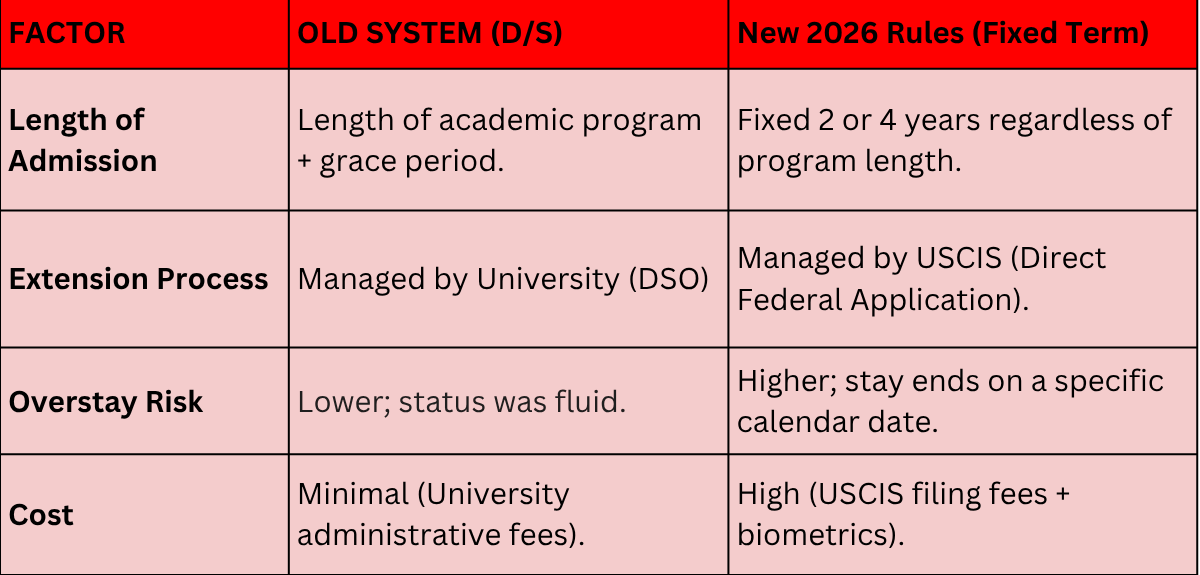
For decades, most F (student), J (exchange visitor), and I (foreign media) visa holders were admitted for Duration of Status. This meant that as long as a student remained enrolled in their program and followed university rules, their legal stay in the U.S. was essentially open-ended. Additionally, they did not need to apply for extensions with the government unless they changed their educational level or transferred schools.
Under the new 2026 guidelines, a fixed date of admission replaces D/S. The U.S. government will now admit most students for a maximum of four years.
However, the government will limit students from countries with high visa overstay rates (exceeding 10%) or those from countries designated as state sponsors of terrorism to a two-year fixed term.
USA Student Visa News: The Impact on the Student Experience
This policy change introduces a significant layer of maintenance for international students. For example, if a student’s program—such as a PhD or a specialized medical residency—lasts longer than their initial fixed term, they must now file a formal Extension of Stay (EOS) application with USCIS.
-
Financial Burden: Each extension application requires a filing fee, which can range from $400 to $700, adding to the already high cost of U.S. education.
-
Biometric Requirements: Students may be required to undergo biometric screening for every extension, adding months of administrative processing time.
-
The ‘Good Cause’ Standard: Extensions are not guaranteed. Students must prove they are making ‘normal progress’ toward their degree and that the delay is caused by compelling academic or medical reasons.
USA Student Visa News: Limitations on Academic Flexibility
The new rules also place a cap on the total amount of time a student can spend in student status. Additionally, the DHS has expressed concern over ‘perpetual students’ who move from one degree to another to remain in the U.S. indefinitely.
-
Degree Limits: Students may be limited to a maximum of two degree changes at the same level (e.g., two different Master’s degrees).
-
Language Training: English as a Second Language (ESL) students will face a strict cumulative lifetime limit of 24 months of study.
Comparative Analysis factoring the new rules

The Rationale for the Change
The administration argues that fixed-period stays are necessary for national security. By requiring students to check in with the government every two to four years, the DHS can verify that the individual is actually attending classes and has not abandoned their primary purpose of stay. Critics, however, argue that the policy will drive top global talent to more welcoming destinations like Canada or Australia, which continue to offer more flexible post-graduate work and residency pathways.
5 Essential Tips for Navigating Fixed-Period Stays
- Audit Your I-94 Immediately: Since status is no longer fluid, your I-94 ‘Date of Admission’ is now the most critical document in your portfolio; check it every time you re-enter the U.S. to ensure the fixed date matches your expectations.
- The ‘Six-Month Rule’ for Extensions: If your program extends beyond your fixed date, begin the Extension of Stay (EOS) process with USCIS at least six months before your current status expires to account for unpredictable processing backlogs.
- Document ‘Normal Progress’ Constantly: Keep a detailed file of transcripts, advisor letters, and medical records; you will need to prove you are making ‘normal progress’ to satisfy USCIS during an extension request.
- Monitor Country-Specific Restrictions: Stay informed on your home country’s overstay rate; if it climbs above 10%, your next entry or extension could be capped at two years instead of four.
- Budget for Federal Fees: Unlike the previous university-led process, federal extensions are expensive; set aside funds for USCIS filing fees and biometric appointments well in advance of your expiration date.

Frequently Asked Questions
What happens if my USCIS extension is still pending when my fixed date passes?
Generally, if you filed a timely and non-frivolous application for an extension, you may be allowed to remain in the U.S. and continue your studies for a set period while the application is adjudicated. However, you should avoid international travel during this ‘pending’ window.
Can my university DSO still extend my status?
No. While your Designated School Official (DSO) still manages your I-20 and academic records, they no longer have the legal authority to extend your ‘Duration of Status’ in the federal system. Consequently, you must apply directly to USCIS for a legal stay extension.
Does this change affect my Post-Completion OPT?
Yes. You will still need to apply for Optional Practical Training (OPT), but your fixed-term admission must cover the period of your employment. If your fixed date expires before your OPT ends, you will likely need to file a concurrent extension.
What if I change my major or transfer schools?
Under the new rules, a transfer or change in major does not automatically reset your fixed date of admission. Instead, you are still bound by the original date stamped on your I-94. If you wish to extend your stay, you must successfully apply for an extension or depart and re-enter the U.S. with a new visa.
Is there a limit on how many extensions I can request?
There is no explicit ‘hard cap’ on the number of extensions. However, USCIS will apply much higher scrutiny to those seeking to remain in student status for more than eight cumulative years. You must provide a ‘compelling academic reason’ for any prolonged stay.
USA Student Visa News: Final Take Away.
For the international student community, the U.S. is no longer a set it and forget it destination. To ensure that an expiring I-94 date does not cut short a PhD or multi-year research project, students must now employ meticulous calendar management and a proactive legal strategy.